00:02
Two seconds between being and not being — where Who Am I? began
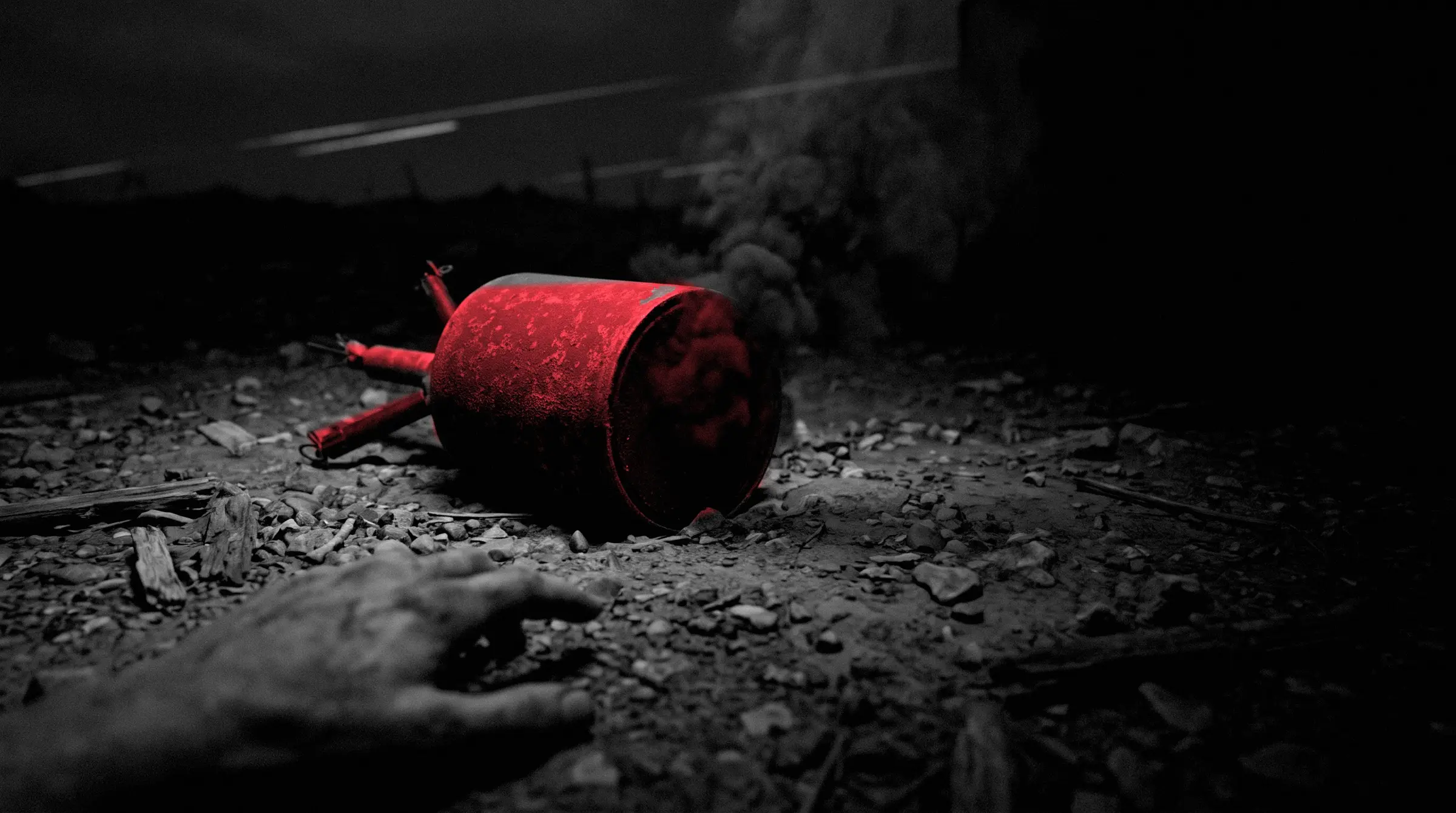
In everyday life, two seconds are worth nothing. But what if two seconds were all you had to find out whether you would live?Two seconds from death…Two seconds from nothingness…Two seconds from dying for people who never valued your life…In that moment, time seemed paralyzed — it would not move, and it held me there with it.The two seconds ended with the dull thud of the mine hitting the dirt. It didn’t explode. I was left with a question:If the universe stretches endlessly before my life and beyond it, and my existence leaves no trace, then what am I alive for?I was eighteen. That night, a question took root in me and would not leave me alone for forty years: Who am I?That was where my search for self-understanding began.
Before you begin
You will not leave this site the same person you were when you arrived.
Who Am I? is not just a question; it is the very nature of our existence. Our failure to truly understand the human being has led not only our personal lives astray, but nations and ideologies as well.
Today we live in the most prosperous and modern civilization in history — a standard of living kings never dreamed of. We have tools that carry voice and image between the farthest corners of the earth without a moment’s delay, yet one in six people is lonely, and loneliness is linked to more than 870,000 deaths every year. Prosperity has reached its peak, yet peace, security and hope for the future shrink day by day; the number of active conflicts between states is at its highest since the end of the Second World War.
This is not a failure to progress; it is a sign that our progress has taken us in the wrong direction. And its root is one thing: we do not know the human being.
This site sets aside the labels attached to human beings and seeks to define us on our own terms — not through an ideology or a single scientific discipline. Along the way, we disentangle our understanding of humanity from creation, religion, politics and money, to see more clearly what we are, what we should do, and what such understanding and change could make possible.
What you will read here was not written to make a name for its author. It grew out of a long journey. We will take it further together.
From a Question to a Civilization
1
Who Am I?
Why did this search begin?
My unconscious mind was still a blank page when the first words were written across it, in a language unfamiliar to me. They were more than words; they bound my worldview to an ideology.
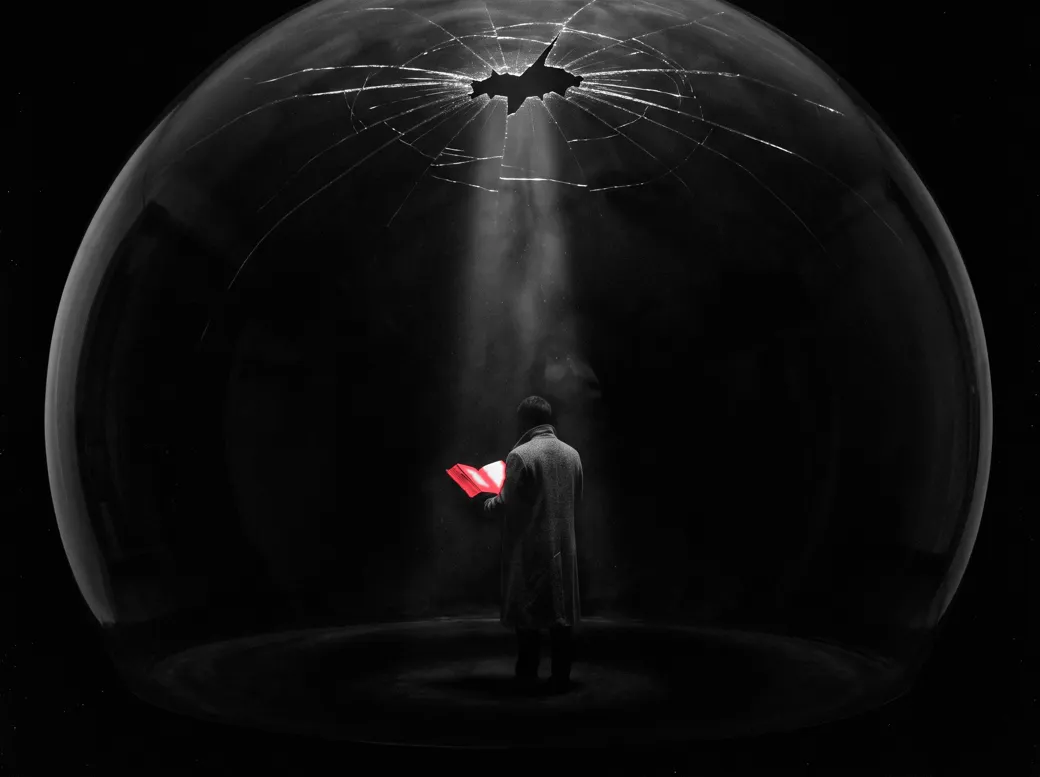
What was inscribed on that blank page could be changed neither from within nor from without. But if life is not only about pleasure for you, and you step back from pleasure a little, a single nudge can burst the fragile bubble of those words, and a different world opens up.
For me, it happened with a book. I was thirty, an intellectually mature adult, when the internet broke through Iran’s closed borders, and Ali Dashti’s Twenty-Three Years was my first real discovery there — the nudge that shattered my glass bubble and sent me back, with every part of my being, to the question born in those two seconds: Who am I? Or, more precisely, what am I?

2
Definition
Who defined us?
Science and ideologies each have a ready answer to “What is a human being?”: a one-dimensional, material creature. Hera was written to give that question a different answer.
On a rainy night, on a dark road, two cars collide: one driven by a thinker, the other by a young woman in a wedding dress, fleeing the celebration of her own captivity. The man is burned so badly that only his brain survives; the woman is left brain-dead. A surgeon who has spent years working on whole-brain transplantation joins the two, and Hera is born: a conscious mind in a body driven by desire.
This is the true image of the human being: a being with two distinct dimensions. Our confusion across millennia comes from mistaking those two dimensions for one.
3
Human
What is consciousness?
To portray consciousness truthfully in Hera’s character, I needed a complete definition of it. That search brought me back to science, which I had set aside for more than three decades — at an age when I was supposed to be retiring, not returning to study.
But science had no complete answer either. There were hundreds of theories, and each had seen consciousness from just one angle — all of them right, none of them whole.
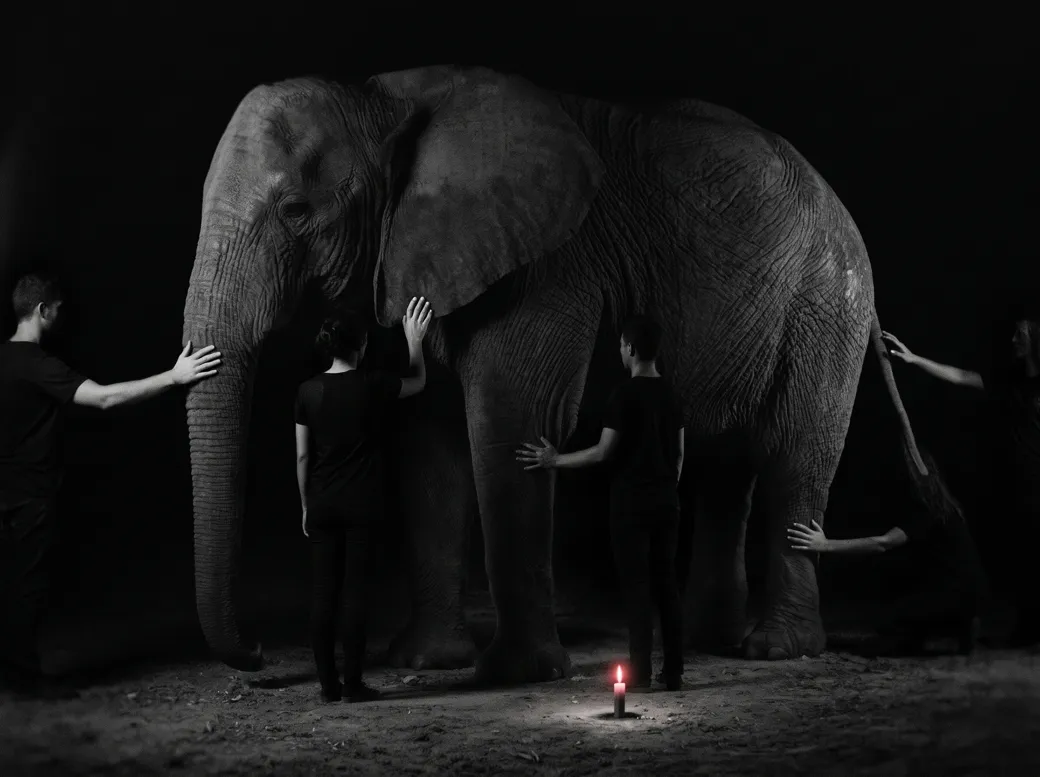
The story of learning had changed too. With humanity’s findings now gathered in one place, this is not the age of discovery; it is the age of finding new insights within what has already been discovered — insights that could not exist without those earlier findings. The RFCP theory is living proof of that. Consciousness had hundreds of definitions from hundreds of angles, like the elephant in the dark in Rumi’s tale. RFCP was the candle that illuminated the connections between those definitions.

Mind
Why was the mind left behind?
When the industrial wave arrived, workers rose up against the machines; they saw machines as competitors for their jobs. But industry spread, and human beings were able to shift the burden of life from their bodies to their brains.
The age of speed began: the speed of machines, of building, of flight, of the internet. And for the first time, humans fell behind their own discoveries. They had always forgotten one part of themselves: the mind.
Just as they gave up their humanity whenever it held them back or could be sold at a profit, they gave up their minds too. They waste their only true assets — time and attention — and call it “killing time.” No living creature gives up its only possession so easily.
What we are losing today is not a contest with artificial intelligence; it is the capacity of our own minds. A phone or laptop with a terabyte of storage slows to a crawl once it fills up with useless data. The brain, sensitive to the smallest piece of information because our survival depends on it, has to consult most of what we have stored for every decision. How can a brain crammed with a jumble of useless information make sound judgments about our present and future, or find the best answer?
Paper
The Insight Gap
Human memory is not small, but it is not infinite either. Not long ago, a single person could be learned and accomplished in several fields. In that setting, education brought about humanity’s greatest leap: the spread of knowledge. Learning was general at first, and only later branched into specialized fields.
Today, what a specialist once spent years learning is within anyone’s reach in moments, and the circle of information is wider still. The rise of artificial intelligence is not something to fear; it is a gift. For the first time, human beings have every means to answer every question: to understand the unknown, give form to what we have yet to grasp, and create what has never existed.
Yet today all the investment pours into advancing AI, while the mind has long been forgotten. We have specialists in abundance, but no thinker who can move among humanity’s findings and arrange them into a new pattern.
The paper The Insight Gap, currently under review, names this very distance: the gap between access to answers and understanding that can be explained and put to use — and it proposes mind management as the way across. AI is not a rival; it is a partner to a mind that can free itself from the grip of daily routine.
Sonic
The First Recognition from an Expert
Getting RFCP, my first paper, onto Academia.edu was a struggle, but it was well received. Still, I needed real validation — from someone who knew science, who had a professor’s rigor, and for whom consciousness was a deep question. I decided to email one of the scholars whose papers I had relied on most. Dirk Meijer, an emeritus professor at the University of Groningen in the Netherlands, whose work I had cited in my theory, did not leave my email unanswered — and his reply was the first good news I had heard in years. He proposed that we write a paper together, on the condition that he would do the writing. He had seen the candle, and my inexperience too. The Sonic theory took shape under the pen of this seasoned and exacting professor. In that paper, Meijer presented RFCP as a unified framework that traces consciousness from oscillations at the Planck scale, the smallest scale in the universe, to resonance with the cosmos.
4
Existence
Were we created, or did we emerge?
Our understanding of human existence is so bound up with an external creator that we can barely imagine ourselves outside that picture. I could not arrive at a complete definition of the human being without first confronting the question of a creator; I had to find out whether creation is the only real possibility for existence, or whether stronger possibilities exist.
In my study of consciousness, I came upon something I had never heard before: the vacuum fluctuates. One question gripped me: if the vacuum fluctuates, could that not be a reliable ground for the emergence of existence?
That question became the key to a theory that not only explains emergence, but proposes that every phenomenon in existence follows a pattern, arising from one shared system. D-TOC traces this path: vacuum fluctuations can become particles through arrangement, pattern, readout, threshold and emergence.
And here the real human question takes shape — where existing beliefs collapse. If we were not created, we owe worship to no one. If there is no heaven and no afterlife, then what do we live for?
5
Civilization
Why is the civilization we built not civilized?
Here the journey brought me back to its hardest question — the one that took shape in those two seconds: if we were not born to worship a creator, and no justice awaits us after death, then what do we live for?
The answer lay not in scripture and commentary, but in a truth nature has kept for millions of years: animal colonies that endure without laws. The name of that truth is civilization. Humanity has yet to build a true one; ancient civilizations barely lasted three and a half centuries on average.
A human being is not a complete creature, but a cell of a superorganism called civilization. Yet self-absorbed individuals claim its achievements as their own. Einstein transformed physics — but without civilization behind him, he might not even have survived.
What we call civilization today is little more than living side by side: people sharing a place with nothing in common, leading tense lives ruled by the law of the jungle and by power, with no clear direction. Our civilization is a wooden house whose inhabitants are termites eating away at its foundations — and such a civilization collapses not with a roar, but silently, from within. Nature is the best teacher: a civilization always falls when its purpose is imposed from outside.
The answer to human purpose lies in defining a true civilization. But what does one look like?
6
True Civilization
What should we build?
If we have a big box full of letters, what do we have? Nothing — because there is no meaning in the box. Meaning appears only when the letters come together in an inner order. That order makes words from letters, sentences from words, pages from sentences, and books from pages.
Human civilization is no exception to this law. But what rule can build a civilization that is not imposed from outside? We need not look far for the answer; it is within us. We only have to ask the question a little better.
Imagine you are a manager entrusted with a vital task that must be done in limited time. You are introduced to twenty specialists, all equally outstanding in expertise and performance. What are your criteria for choosing?
Isn’t it that you choose those you can trust to be honest and upright? Those who are committed to the same goal and willing to work together to achieve it? Those beside whom, because of that very trust, you feel safe and at peace? And can such a group endure together without a bond of kindness and humanity?
No one taught you these criteria; they are in all of us. Trust, shared purpose and cooperation are not only true ethics — they are the very order a civilization needs. True civilization grows from within us.
The Civilizational Republic is a bridge between civilization as it exists today and civilization as it could truly be.
7
Civilizational Republic Coming soon
Power is not centralized; purpose is.
Toffler divided human civilization into three waves, and Harari saw it in shared stories and myths; but neither looked at civilization through its true lens — the human being. Toffler began civilization with agriculture and left it in a third wave that shattered the very idea of civilization: a society of scattered “I”s, each wanting everything for itself, unable even to live under one shared roof. Yet this is not the end of civilization; it is its beginning — the point where the human being, reduced to an “I”, finds itself alone in the heart of civilization.
The Fourth Wave sees Toffler’s third wave as even shorter than the second, and shows that humanity has reached the point where the “I” has become the final dead end on a road humanity mistook for progress. The Civilizational Republic is the passage from Toffler’s third wave to civilization’s fourth wave — the wave of consciousness — where human beings come to know their own reality and focus their purpose on it.
The Civilizational Republic rests on a charter shaped neither by political agendas, nor by religion or ideology, and measured by the development of civilization itself rather than the interests of any individual or group. At its heart lies a hundred-year plan for civilization and progress, carried out in four-year terms by elected governments that are bound to implement it. From the first line of the charter, to the constitution written from it, to every election, people take a real part at every stage — not just a single “yes” vote.
In this vision, power is not centralized; purpose is — focused on what makes civilization flourish, not on serving the interests of any individual or group.
Book · In progress
Who Am I? The shortest question, with an answer as vast as all there is to know
Nothing explains Who Am I? better than the life and the road that brought me here. Who Am I? weaves together the story of what I saw with what I came to understand. Criticism carries no weight until its reasons are clear; so I try to bring what I have lived and what I have found into one book, side by side.
The book is told by a man whose life began in a poor alley of a town far removed from the wider world. He was born into a narrow worldview — one instilled in him before he even knew he existed. His childhood was trapped in the fear of shouting voices and clenched fists: people shouting for something they did not understand — the revolutionaries of 1979. His youth came face to face with death in a war that had no logic but power — the Iran–Iraq War. And he began his independent life, outside religious and ideological commands, not in a classroom but with a book — a book that shattered the glass bubble of his beliefs. It took thirty years for that wound to heal. Through it, he found his way out of servitude and toward reality.
The life behind this book has already been lived. The book itself, we will shape together. Who Am I? will be published in installments on this site and refined through constructive feedback from thoughtful readers.
Follow and share your thoughts