

New Lens

New Lens

March 25 / 2026 / 4:00 PM

Consciousness as a Resonance Frequency Coding Principle (RFCP)
Wave Resonance and the Emergence of Coherence from Planck Scale to the Cosmos


Abstract
Consciousness, despite its foundational role, remains one of the most enigmatic phenomena in the universe. Previous attempts to reduce it to purely physical processes or to explain it within classical philosophical frameworks have largely failed, underscoring the need for interdisciplinary and empirically testable models.
This article presents an in‑depth analysis of the Resonance Frequency Coding Principle (RFCP) as a unifying theoretical framework for understanding consciousness. RFCP integrates recent advances in neuroscience (GNW, IIT), biophysics (CEMI), quantum physics and cosmology, and—building on a Geometric Conservation Law—proposes that consciousness arises from multi‑scale resonance patterns, ranging from Planck‑scale and microtubular oscillations up to interactions with cosmic fields.
The framework combines empirical testability (EEG, MEG–based measures), quantitative indices of consciousness, and a new pathway toward addressing both the hard problem of consciousness and the explanatory gap.
Keywords: consciousness theory · RFCP · wave‑like consciousness · qualia · hard problem · biophysics · geometric conservation law · neurogeometry · EEG · MEG

March 25 / 2026 / 4:00 PM

The Sonic and Conscious Universe:

Transactional Wave Resonance Creates Coherence from Planck to Cosmic Scales, as a Basis  for Human Intelligence and Unified Cosmo-Psychism

The Sonic and Conscious Universe: Transactional Wave Resonance Creates Coherence from Planck to Cosmic Scales, as a Basis  for Human Intelligence and Unified Cosmo-Psychism
Dirk K. F. Meijer, em. Professor, University of Groningen, The Netherlands.  mail: me******@****et.nl
Mohammad (Dadar) Forghani, Independent Researcher, Markham, Canada. mail: fo*********@***il.com

Summary
A resonant frequency is the natural frequency at which a system oscillates with the greatest amplitude when it receives energy. When an external force matches this frequency, the response is amplified. Resonance phenomena occur with all types of vibrations or waves. Resonance of coherent (phase locked) wave states in brain can stimulate intra- and inter-brain communication and awareness/consciousness. Consciousness remains one of the most profound mysteries in science, resisting reduction to purely physical or philosophical explanations. This essay presents an in-depth analysis of the Resonance Frequency Coding Principle (RFCP) as a unifying theoretical framework for understanding consciousness. RFCP integrates insights from contemporary neuroscience, quantum physics, biophysics, and cosmology, proposing that consciousness emerges through multi-scale resonance patterns spanning from quantum microtubular oscillations to cosmic field interactions. We explore seven hierarchical levels of resonance interaction, examine the implications for temporal experience, and address fundamental questions in the philosophy of mind, including the hard problem of consciousness. Drawing on recent theoretical developments in Integrated Information Theory, electromagnetic field theories, and quantum consciousness models, we argue that RFCP offers a comprehensive, testable framework capable of bridging the explanatory gap between physical processes and subjective experience.
Keywords: Consciousness, Resonance, Frequency coding, Integrated Information Theory, Quantum Cognition, Electromagnetic Fields, Microtubules, Cosmic consciousness, Temporal Experience

March 25 / 2026 / 4:00 PM

Data Transfer to the Brain
The Next Bottleneck – and Possible Dead End – of Human Civilization, and a Different Way Through

Science pursues the “how” of a finger’s movement — but consciousness is the reason behind that movement. The same finger can point, caress, or pull a trigger. RFCP proposes that the real solution lies not in the speed of data transfer, but in creating the conditions for resonance between living minds — a network of consciousness, not of data.

Abstract


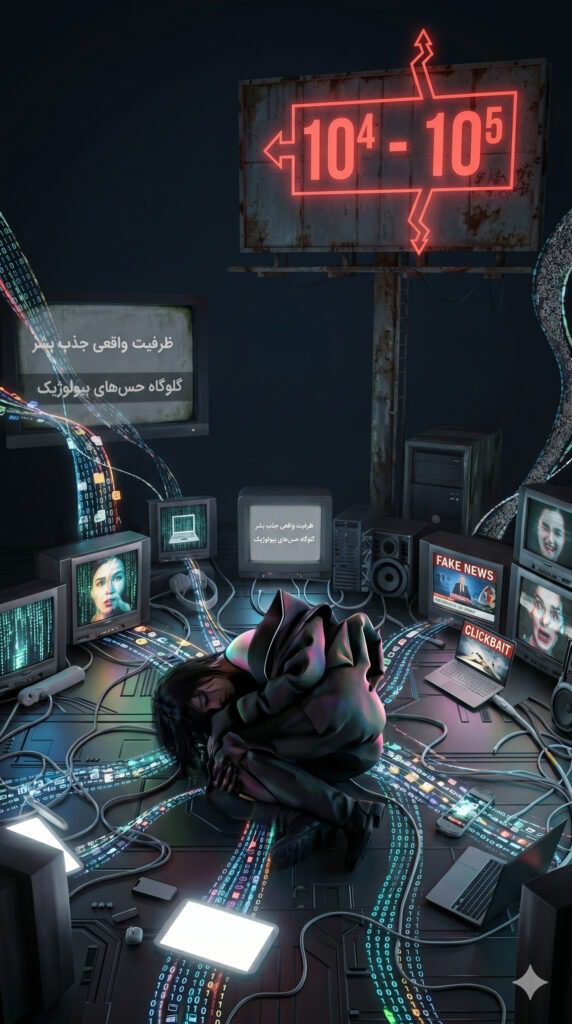
Humanity has entered a paradoxical phase: we generate more digital data than at any point in history, yet our capacity to absorb and share meaning has barely changed. Recent estimates suggest that global data production is on the order of hundreds of millions of terabytes per day, while the effective conscious bandwidth of a single human—constrained by reading and language—is on the order of only 10–30 bytes per second. This implies a civilization‑scale gap of roughly  between what is produced and what can actually be taken up into human awareness. At the same time, algorithmic curation in social media and AI‑driven platforms systematically amplifies emotionally engaging, low‑value, or misleading content rather than high‑value knowledge, turning the limited cognitive capacity of humans into a scarce resource increasingly spent on information with negative or even anti‑evolutionary epistemic value.
Most technological responses—faster networks, more efficient compression, and even brain–computer interfaces—implicitly treat consciousness as if it were a code that can be extracted, transmitted, and rewritten elsewhere. In contrast, contemporary neuroscience and theories of consciousness converge on a different view: consciousness is better understood as a set of dynamically organized states of a living system, not as a store of transferable symbols. From this perspective, merely accelerating symbolic transfer cannot solve the underlying bottleneck.
This concept paper introduces the Resonant Frequency Coding Principle (RFCP) as a directional framework rather than a finished solution. RFCP proposes that instead of trying to copy and inject content between brains, we should explore architectures that enable state alignment through shared resonant fields, so that each brain can, according to its own processing capacity, construct meaning endogenously from a cleaner, less manipulated substrate. The present paper does not disclose engineering details; its aim is to articulate the bottleneck, critique the prevailing symbolic paradigm, and invite collaborative experimental work on non‑symbolic, resonance‑based approaches to large‑scale human communication.
Keywords (English)
Information overload; Human conscious bandwidth; Brain–computer interfaces (BCI); Symbolic vs non‑symbolic communication; State alignment; Resonant Frequency Coding Principle (RFCP); Awareness networks

Shopping Cart
Scroll to Top